
Piling & Deep Foundations
Where shallow foundations cannot carry the load or control settlement, piles transfer load through weak layers to competent strata. Pile type is selected from the ground, the loads, the site constraints and the verification regime.
Piling & Deep Foundations methods
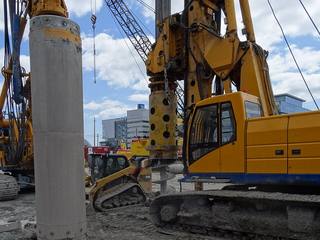
Bored Piles
Cast-in-place reinforced concrete piles formed in a drilled shaft, for high loads and large depths.
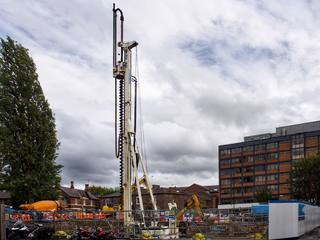
Continuous Flight Auger Piles
Concrete pumped through a hollow auger as it is withdrawn; fast, quiet and low-vibration.
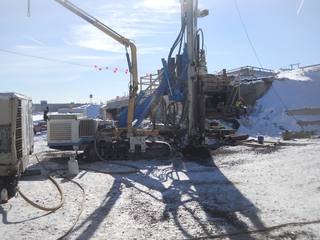
Micro Piles
Small-diameter drilled and grouted piles for underpinning, tight access and tension loads.


How the pile types compare
A qualitative guide only. Pile type and size are selected by design from the ground, the loads and the site constraints.
| Pile type | How it is formed | Typically considered for | Main constraints |
|---|---|---|---|
| Bored PilesCast in place | Shaft drilled, supported by casing or fluid where needed; cage and tremie concrete | High loads, large diameters and depths, rock sockets | Shaft stability in loose or water-bearing soils; spoil handling |
| CFA PilesCast in place | Concrete pumped through a hollow auger as it is withdrawn; cage pushed in | Medium loads, fast production, low noise and vibration | Cage length and pile size limited by the rig; hard layers |
| Micro PilesDrilled and grouted | Small-diameter hole, steel bar or tube, cement grout | Underpinning, restricted access, tension and compression | Lower capacity per pile; buckling in very soft soils |