
Ground Improvement
Ground improvement, also called soil improvement, is engineered to meet a performance requirement. We start from the ground condition and the required performance, select the densification method, prove it in a trial area, control production and verify the result.
Ground Improvement methods
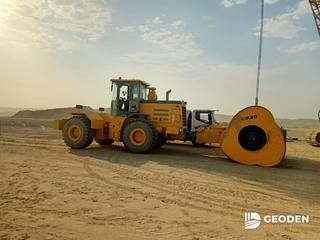
High Energy Impact Compaction
A towed non-circular roller delivers high-energy impacts to compact large areas and near-surface layers.
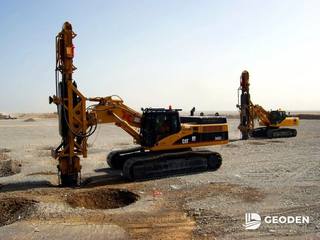
Rapid Impact Compaction
A hydraulic hammer strikes a steel foot that stays in contact with the ground, in rapid, controlled blows.
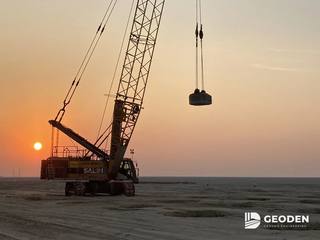
Dynamic Compaction
A heavy weight dropped from a crane on a planned grid densifies loose granular soils and fills to depth.
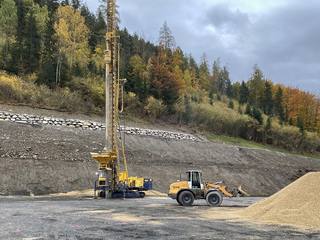
Vibro Compaction
A depth vibrator rearranges sand grains into a denser state; suited to clean sands and hydraulic fills.


How the methods compare
A qualitative guide only. Achievable depth and performance depend on the soil, groundwater, equipment and parameters, and are confirmed by trial.
| Method | How energy is applied | Typically considered for | Relative treatment depth | Main site constraints |
|---|---|---|---|---|
| High Energy Impact CompactionHEIC | Towed non-circular roller | Large-area fills, earthworks platforms, roads and laydown areas | Shallow (near-surface layers) | Needs large, open, trafficable areas for runs at speed |
| Rapid Impact CompactionRIC | Hydraulic hammer on a steel foot in contact with the ground | Granular soils and fills where more controlled energy is needed | Shallow to moderate | Lower vibration than DC, but still monitored near existing assets |
| Dynamic CompactionDC | Free-fall weight dropped from a crane | Loose granular soils, mixed fills, collapsible soils over large open areas | Deepest of the impact methods | Ground vibration and flying debris; needs clear space from structures and services |
| Vibro CompactionVC | Depth vibrator inserted into the ground | Clean sands with low fines content, hydraulic fills | Deep | Not effective where fines content is high; needs water supply |
Common questions
Which method is right for my site?
It depends on the soil types and density, groundwater level, required treatment depth, performance criteria, site area and proximity to existing structures. We recommend a method after reviewing the site investigation, and confirm it with a trial area.
Why is a trial area needed?
A trial calibrates production parameters (such as energy, spacing and number of drops or passes) against measured results before full production starts. That reduces risk for the client and the consultant.
How is the improvement verified?
Typically by comparing in-situ tests before and after treatment, such as CPT or SPT, and by plate load tests or settlement monitoring. Production control records and acceptance testing are kept separate.